

Signs, Symptoms, and Solutions for Poor Thyroid Function – Benefits of Iodine
16th Sep 2022
Signs,
Symptoms, and Solutions for Poor Thyroid Function –
Benefits of Iodine
Hypothyroidism is far more prevalent than once thought. The latest estimates are that 20 million Americans have hypothyroidism, but the actual numbers are probably higher.
Some experts claim that 10 to 40 percent of Americans have suboptimal thyroid function.
Thyroid hormones are used by every cell of your
body to regulate metabolism and body weight by controlling the burning of fat
for energy and heat. Thyroid hormones are also required for growth and
development in children.
Iodine is Key for Thyroid Health
Iodine is the key to a healthy thyroid and efficient metabolism, and even comprises a large part of the thyroid hormone molecule itself.
Even the names of the different forms of thyroid hormone reflect the number of iodine molecules attached -- T4 has four attached iodine molecules, and T3 (the biologically active form of the hormone) has three -- showing what an important part iodine plays in thyroid biochemistry.
Iodine deficiency is one of the three most common nutritional deficiencies, along with magnesium and vitamin D (which, by the way IS a hormone).
Since iodine is so important for thyroid function, wouldn’t you expect to see an increase in hypothyroidism with insufficient iodine levels?
Yes, and that is exactly what we have seen.
This means that your thyroid problem could be an iodine deficiency problem.
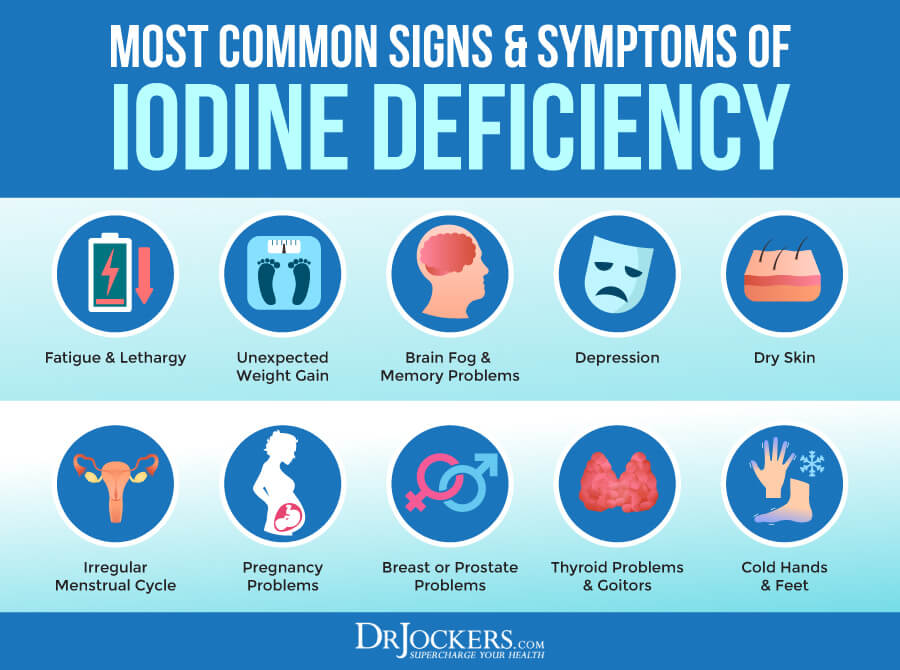
If you feel sluggish and tired, have difficulty losing weight, have dry skin, hair loss, constipation, or cold sensitivity, it could all be related to hypothyroidism.
More than 100 years ago, iodine was shown to reverse and prevent goiter (swelling of your thyroid gland) and to correct hypothyroidism. But we now understand that iodine’s effects are much farther reaching.
Iodine has many important factors in your body: Here are four.
1.Stabilization of metabolism and body weight
2.Brain development in children
3.Fertility
4.Optimization of your immune system (iodine is a potent anti-bacterial, anti-parasitic, anti-viral and anti- cancer agent)
While iodine levels have fallen, there have been simultaneous increases in rates of thyroid disease, breast cancer, fibrocystic breast disease, prostate cancer, and obesity in American adults, and an increase in mental retardation and developmental delays in American children.
Why are Iodine Levels Dropping?
Iodine deficiency is on the rise in the United States. Simple supplementation may not be the answer as the following issues also need to be addressed.
Recent national survey data suggest that just over 11 percent of the total U.S. population, and over 7 percent of pregnant women, and nearly 17 percent of all reproductive-aged women, are deficient in iodine.
The Total Diet Study, performed by the FDA, reported an iodine intake of 621 µg for 2-year-olds between 1974 and 1982, compared with 373 µg between 1982 and 1991. During this same period, the baking industry replaced iodine-based anti-caking agents with bromine-based agents.
In addition to iodine’s disappearance from our food supply, exposure to toxic competing halogens (bromine, fluorine, chlorine and perchlorate) has dramatically increased.
You absorb these halogens through your food, water, medications, and environment, and they selectively occupy your iodine receptors, further deepening your iodine deficit.
Fluoridation of water is a major contributor to iodine deficiency, besides being very damaging to your health in many other ways.
Additional factors contributing to falling iodine levels are:
The Toxic Halides -- Iodine’s
Fiercest Competitors
Iodine is a member of a class of related elements called “halogens” that includes bromine, fluorine, and chlorine. When they are chemically reduced, they become “halides”: iodide, bromide, fluoride, and chloride. These are the forms you usually encounter in your foods, medications, and environment.
Iodide and chloride are beneficial in small amounts, but bromide and fluoride are toxic. They grab onto your iodine receptors, blocking the action of iodide and thyroid hormones, resulting in, or at least contributing to many serious diseases.
One of the main problems is that the toxic halides become stuck in your body.
There is no known detoxification pathway for
bromine and fluorine -- your body simply cannot break them down. So, they build
up in your tissues and wreak havoc on your health.
Bromides
Bromides are a menace to your endocrine system and are present all around you.
Despite a ban on the use of potassium bromate in flour by the World Health Organization, bromides can still be found in some over-the-counter medications, foods, and personal care products.
The use of potassium bromate as an additive to commercial breads and baked goods has been a huge contributor to bromide overload in Western cultures.
Sodium bromate can be found in products such as permanent waves, hair dyes, and textile dyes.
Benzylkonium is used as a preservative in some cosmetics. Even trace amounts of bromine can trigger severe acne in sensitive individuals. And who needs skin care products that cause acne?
Bromine is also found in fire retardants used in carpets, mattresses, upholstery, and furniture and some medical equipment.
Based on animal research, bromides have been linked to behavioral changes and neurodevelopmental disorders, including attention deficit disorders, in children.
The United States is quite behind in putting an end to the egregious practice of allowing bromine chemicals in your foods and products whereas other nations have taken the bull by the horns:
Again, corporate profits trump health concerns when it comes to doing what is best for the public.
Great Resource for Learning More
Author and patient advocate Mary Shomon is one of the leading educators on thyroid health in the U.S. Mary cautions thyroid patients not to run out to the health food store and load up on iodine or iodine-rich supplements like kelp and bladderwrack.
According to Mary, in someone who is not iodine-deficient, excessive iodine supplementation can worsen a pre-existing thyroid condition or trigger further thyroid dysfunction. The key is in getting the right amount of iodine -- not too much, not too little.
Getting Your Iodine Levels Up
If you are iodine deficient, I recommend adding sea vegetables to your diet.
The best source of organically bound iodine that I know of is non-commercially harvested seaweeds. The dose is about 5 grams a day or about one ounce per week, so a pound would last about two months.
It is typically better to obtain a nutrient from a natural food whenever possible than from a supplement, however, convenience is often more doable, therefore, a list of all our 100% natural supplements to help support our thyroid is listed below. Read through each one to see if they resonate with you.
Some patients also report that they respond better to food-based forms of iodine -- like seaweeds
The fact that your thyroid only transports iodine in its ionized form (i.e., iodide) is straight out of the textbooks. Your thyroid reduces iodide (I-) into iodine (I2) for use in formation of thyroglobulin. Your body doesn’t utilize iodine directly. It has to split the I2 into two I- ions, which is an oxidative reaction that causes oxidative stress. Iodide transporters are located in other areas of your body besides the thyroid gland, including your breasts, often needed to prevent breast cysts and colon. One family of iodide transporters is called the sodium-iodide symporter, and the other is called pendrin. Dr. David Brownstein (see below) discusses the sodium-iodide symporter but doesn’t mention pendrin. However, like all ion transporters they too require a charge to move a molecule across the membrane, which means iodine must be in its ionized form.
It’s possible that some may see good results using Lugol’s for some afflictions, but according to autism expert Catherine Tamara, in her experience it is very clear that children with autism, and their mothers, do fine with iodide, but not necessarily with iodine.
Keeping your iodine levels optimal is
particularly important if you are a woman that is contemplating pregnancy or
are already pregnant. Make sure you are taking seaweed or a prenatal vitamin
with the right amount and form of iodide, not iodine, to help protect your
baby.
Tips for Optimizing Thyroid
Function
Laura Power, MS, PhD, LDN, offers these suggestions for increasing secretion of fluorine and bromine::
This is a surprising and shocking injustice that is occurring in the U.S. right now.
The FDA has shut down natural desiccated thyroid drug production and distribution by three major firms and is now calling the century-old natural remedy an “unapproved drug.”
One of the ways you can typically differentiate a natural physician from a conventional one is by the type of thyroid hormone replacement therapy they prescribe. Natural physicians will almost exclusively use desiccated thyroid hormone products like Armour Thyroid.
Dr. says - I have put thousands of patients on this and it was my consistent experience that most did far better on these than the synthetic versions. About the only exception were people that were taking synthetics for longer than 10 years. Seems like their body had a tough time adjusting back.
Taking desiccated thyroid hormone off the market will cause harm, danger, and damage to hundreds of thousands and perhaps more than that, unless they are allowed access to this safe and superior thyroid replacement.
Two other major manufacturers/distributors now have long-term backorders for their bioidentical hormone products, which include Armour, Nature-Thyroid, and Westroid.
The uncertainty about the future of natural thyroid drug options has many patients and practitioners concerned.
If you’re newly diagnosed with hypothyroidism or have not been on synthetic hormones for very long, I strongly recommend Armour Thyroid -- a natural porcine thyroid extract, which provides not only T3 and T4, but also T1 and T2, which will help normalize your hormone response.
The fact that the FDA may now severely limit,
or eliminate, this option is distressing, as it is clearly the best option for
many people. Nonetheless, the products listed below will provide more than
adequate supplementation to support the function of your thyroid.
**** A simple and effective test to see if you are iodine deficient ****
Put 8-10 drops on the inside of your wrist and
rub both wrists together until well absorbed (this will leave a yellow stain).
Do this at bedtime. If when you wake in the morning and all the yellow stain is
gone will confirm you NEED iodine. Doing this each night will allow you to see
clearly when you have sufficient iodine. When you have enough, the yellow stain
will still be visible on your wrist when you wake up.
Recommended Products: