

BRAIN HEALTH AND B-VITAMINS: ESSENTIAL FOR MIND, MOOD & MEMORY
11th Mar 2024
Your Brain will Thank You!
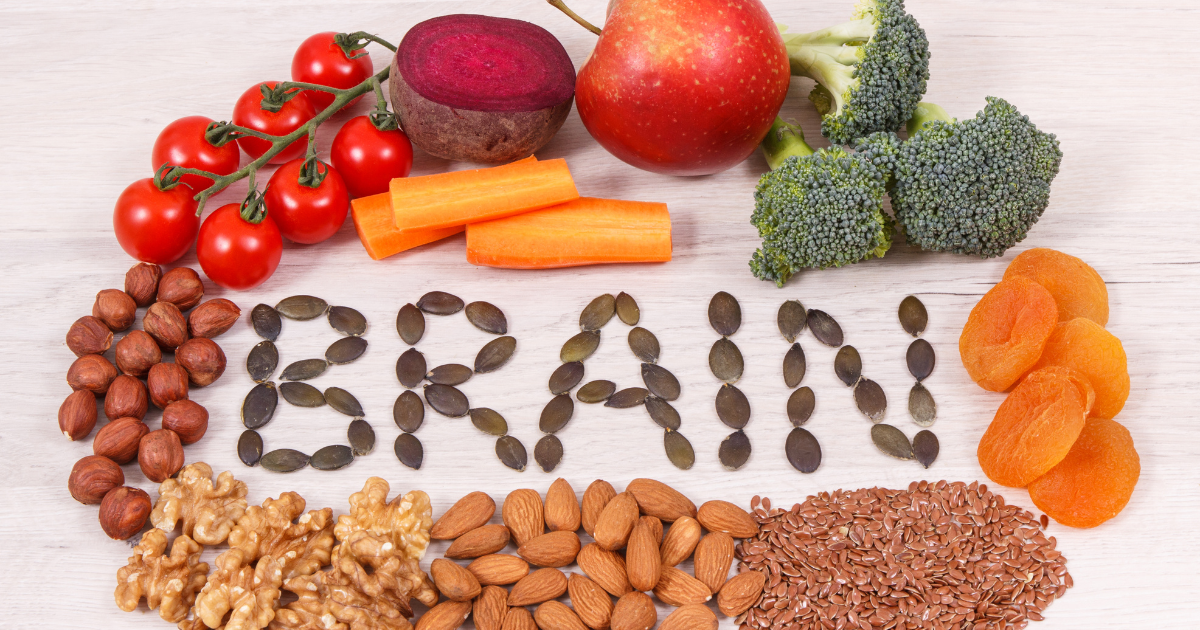
As a wellness practitioner rooted in integrative, quantum health, we understand the interconnectedness of mind, body, and spirit. Therefore, it is crucial to acknowledge the significant impact that nutrition has on our brain function and overall well-being.
Neurotransmitters, which are the chemical messengers in our brain, play a pivotal role in regulating our mood, emotions, and cognitive abilities. B vitamins are essential to produce neurotransmitters such as serotonin, dopamine, and norepinephrine, which are crucial for maintaining optimal mental health.
In this blog, we will explore the science behind B vitamins and how they support neurotransmitter health and brain adaptability. We will also discuss the various food sources and supplements that provide B vitamins, as well as how to optimize their absorption and utilization.
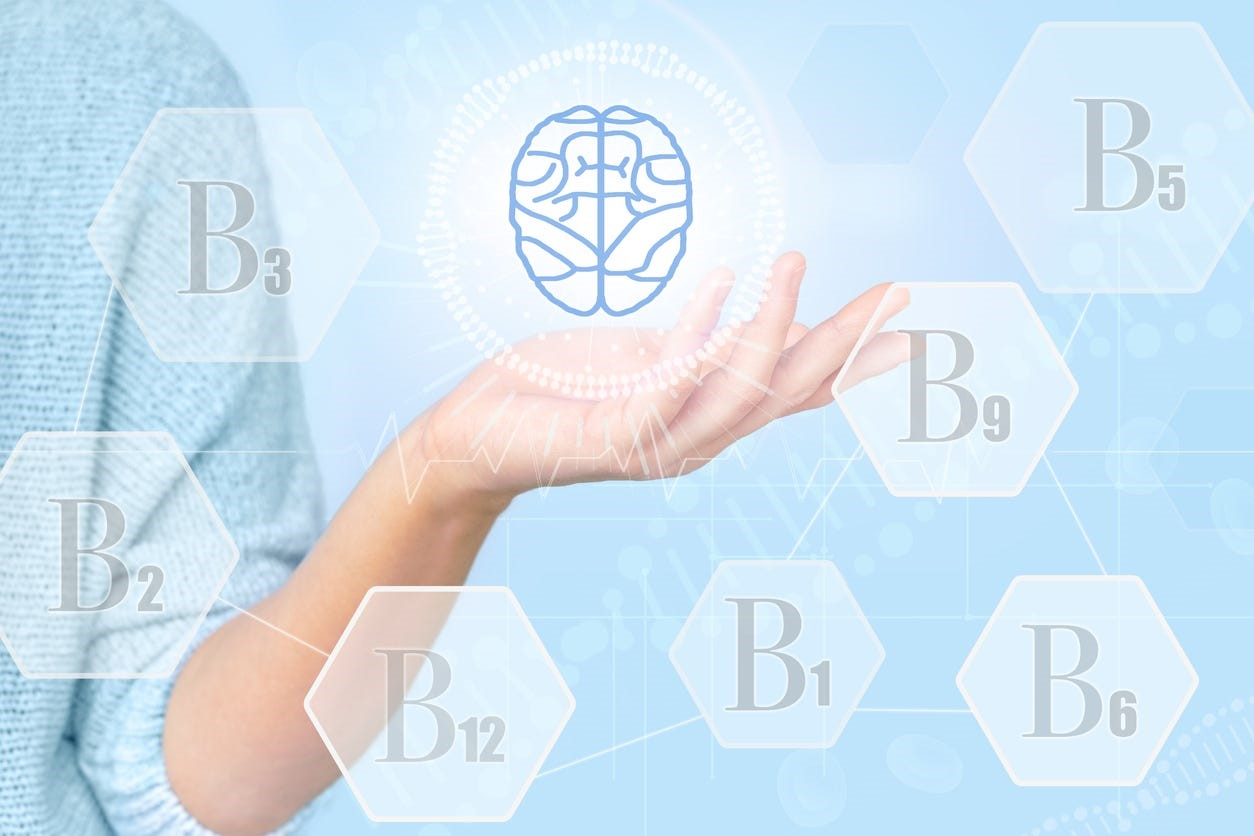
B-VITAMINS: THE CONDUCTORS OF CELLULAR RESONANCE & NEUROTRANSMITTER ADAPTABILITY
Vitamins are organic compounds considered essential for normal physiological functioning but are not made endogenously by the body. Every single day, a variety of essential nutrients must be extracted and utilized from our diet. Healthy human bodies require adequate amounts of 13 vitamins; four fat-soluble vitamins (A, D, E, K), and nine water-soluble vitamins, which include vitamin C and the eight B vitamins: thiamine (B1), riboflavin (B2), niacin (B3), pantothenic acid (B5), pyridoxine (B6), folate (B9), and vitamin B12. Despite being grouped, B vitamins have no chemical structure similarity but instead, set themselves apart by their water solubility and the inter-related, co-enzyme functions they facilitate.
Synergistically B vitamins have a vital role in cell function and act as co-enzymes in numerous catabolic and anabolic enzyme reactions. Evidence suggests that adequate amounts of EACH of the eight water-soluble B vitamins are essential for optimal physiological and neurological functioning. B-vitamins are involved in energy production, DNA/RNA synthesis/repair, genomic and nongenomic methylation, and are crucial for the synthesis of numerous neurochemicals, signaling molecules, and ultimately, neurotransmitter adaptability.
Furthermore, brain adaptability, or neuroplasticity, is a crucial concept that highlights the brain’s ability to change and adapt in response to new experiences and environments. B vitamins have been shown to promote brain adaptability, which is critical for learning, memory, and overall cognitive function.
BRAIN-SPECIFIC ROLES OF B VITAMINS
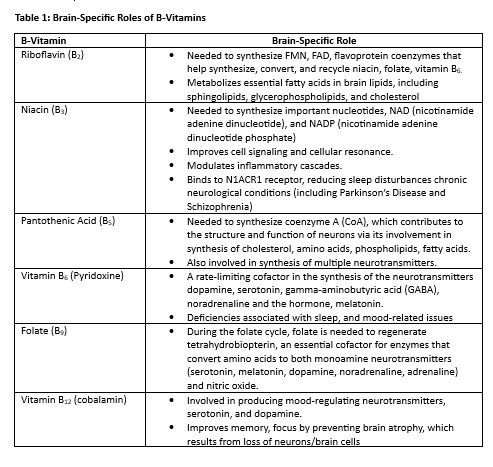
Accounting for more than 20% of the body’s total energy expenditure, the brain is the most metabolically active organ of the body. The importance of B vitamins as fuel for the brain is evident by the fact that each B vitamin is actively transported across the blood-brain barrier via dedicated transport mechanisms. Levels of these essential B vitamins are tightly regulated by mechanisms responsible for maintaining homeostasis, resulting in lower concentrations of B vitamins in the blood, and higher concentrations in the brain. Many of the B vitamins directly or indirectly influence brain health and function. Table 1 below highlights important, brain-specific roles that several B vitamins fulfill.
Regarding neurological disorders, evidence reveals that deficiencies in key B vitamins may be at the root of neurological disorders, psychiatric diseases, and dementia. For example, insufficient amounts of B6 are associated with depressed mood, irritability, suboptimal cognitive performance, and poor mental health.
A deficiency of B12 manifests as neurological impairment initially and can result in pernicious anemia when there has been an extended period of B12 deficiency.
Epidemiological evidence reveals that B-vitamin deficiencies are prevalent worldwide, including in developed countries. In the absence of an optimal diet, supplementing with the entire array of B vitamins, in therapeutic doses, may be a rational approach for preserving brain health.
However, with an over-emphasis on examining what B-vitamin deficiencies look like and how to meet the minimum daily requirements, there is no clear understanding of what optimal B-vitamin status would look like and if it may be associated with healthy aging and maintaining healthy brain function.
Vitamin deficiency has been linked to a higher occurrence of psychiatric and cognitive disorders.
It is suggested that 40% of the population suffers from a genetic mutation compromising the proper conversion of unmethylated B vitamins. Without proper methyl transfer for homocysteine modulation, the necessary formation of methyl donors involved in cardiovascular, neurological, reproductive, and detoxification functions cannot be adequately produced. Individuals most likely to benefit from B-vitamin supplementation have higher baseline homocysteine levels which are linked to cognitive deficits in subpopulations with a higher incidence of depression, schizophrenia, and dementia.
Given the synergy involved between B vitamins and energy metabolism, B-vitamin supplementation is generally recommended to supplement with the whole vitamin B-complex family, in addition to isolated Bs (such as B12, folate, B6, or Biotin) that may already be a part of personal supplement protocols. Vitamin B supplementation needs to be delivered in their biologically active blood circulating forms. The whole B-vitamin family is needed to help keep the body in balance and harmony for greater physical, emotional, and mental health. Especially during times of high emotional or physical stress, as well as phases of life that require greater physical and/or mental stamina, supplementing with B vitamins may improve energy levels, neurotransmitter adaptability, and ultimately quality of life. Especially necessary before, during, and after surgery.
MODERN DIETS ARE INHERENTLY DEFICIENT
Aside from diet and genetics, levels of B vitamins in the body are affected by numerous factors including age and environment. A deficiency in B vitamins is associated with several neurological conditions including depression, anxiety, dementia, and Alzheimer’s disease. Not only are B vitamins important for brain function but several clinical studies indicate that they have a beneficial role in mood stabilization and stress management. Additionally, the influence of diet on brain health has been considered a modifiable risk factor to prevent mood disorders. Up to 30% of patients diagnosed with depression have elevated homocysteine levels. According to meta-analysis and systematic review of B-vitamin supplementation on depressive symptoms, anxiety, and stress, nutritional interventions designed to improve diet quality are associated with a reduction in depressive symptoms, independent of self-assurance and physical activity levels. To prevent deficiency-related disorders, it is important to optimize mood and well-being for all individuals. This includes optimal nourishment, quiet self-reflection and meditation, compassionate counseling, and bodywork such as the Emotional Freedom Technique (EFT) or massage therapy.
As a wellness practitioner, we must have a holistic approach to dietary supplementation with B vitamins. Due to the complex, interconnected nature of B vitamin absorption, metabolism, and function, all B vitamins should be considered for supplementation before limiting protocols to vitamins B6, B12, and folate, the three most extensively studied B vitamins. It is important to note that folate supplementation can mask B12 deficiency, which can be highly problematic in the long run as far as brain health goes. Additionally, utilizing the ‘activated’ forms of B-vitamins, obtained via natural fermentation methods, are the most bioavailable and are most beneficial for strict vegetarians or vegans, those having absorption or digestive issues, elderly populations, those who consume the SAD, inherently high in refined or processed foods, as well as those who have the MTHFR polymorphisms. Now more than ever, high-quality, activated B-vitamin supplements are an essential ally to mind, mood, and memory and build optimal health!
Aiding the brain further it is imperative the brain receives adequate FAT. Good fats ( Never canola oil, vegetable oil, or seed oils of any kind). To enhance brain function, daily doses of EPA/DHA are recommended (if a head injury is ever involved then higher doses are required for about two weeks).
Daily dosing of EPA/DHA also helps aid kidneys, heart, vision & joint health.
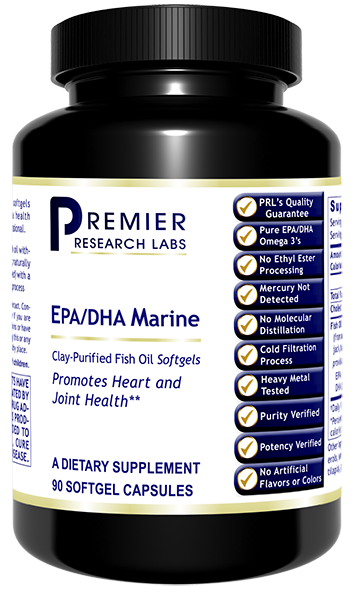
EPA/DHA Marine Softgels Clay-purified fish oil concentrate for brain, kidneys, heart, vision & joint health
Niacin, Premier Dietary Supplement 60 Plant-Source Capsules Vitamin B3 as Inositol Hexanicotinate

B-12 ND (2 fl oz) Memory-Mood-Cognitive Health-Homocystein Modulation-Neurological Function-Energy
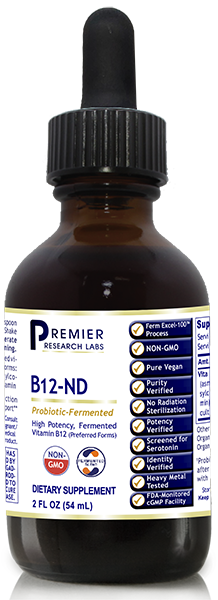
Max B-ND™ Dietary Supplement 8 fl oz (235 mL) Probiotic-Fermented Vitamin B Complex